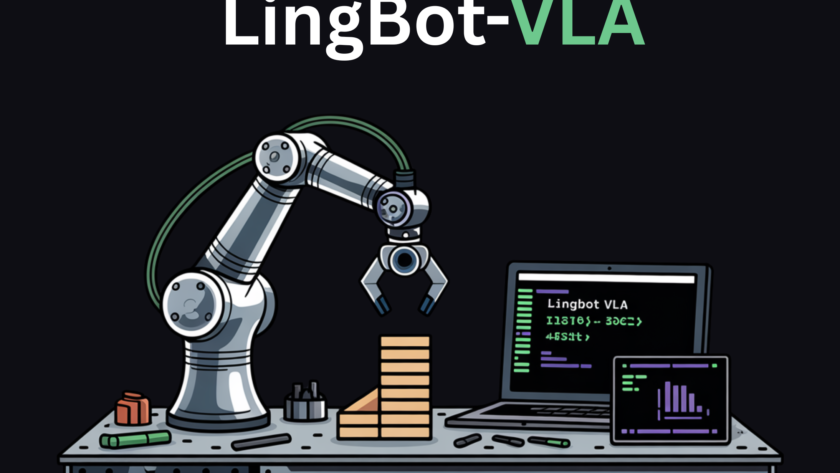
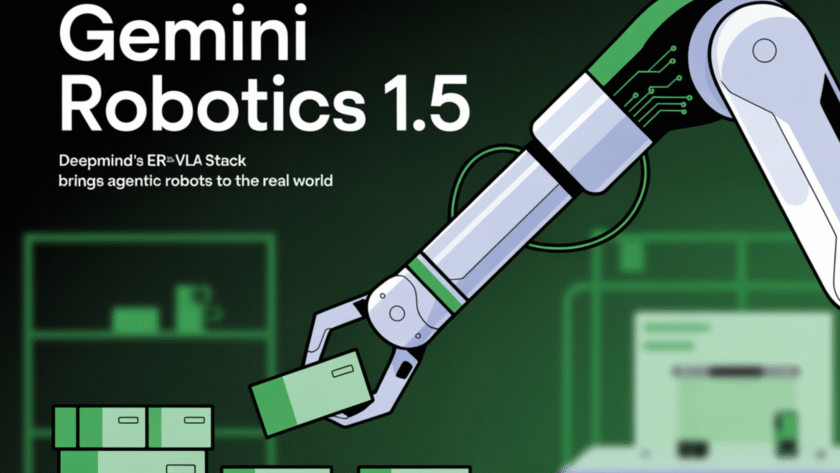
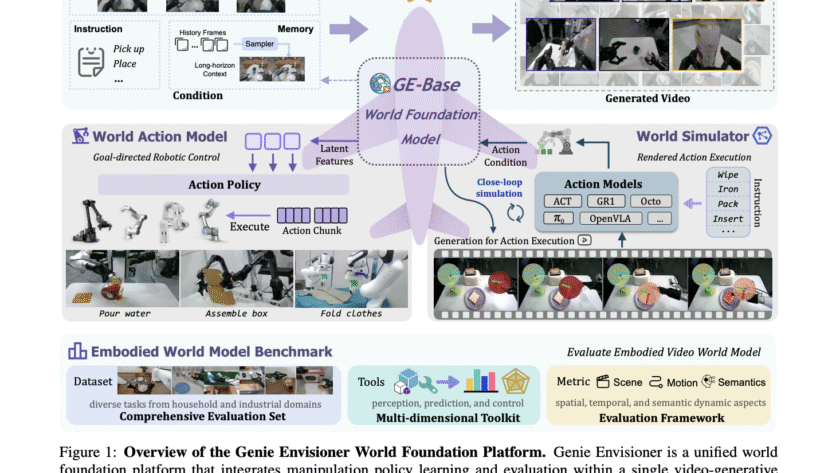
Embodied AI agents that can perceive, think, and act in the real world mark a key step toward the future of robotics. A central challenge is building scalable, reliable robotic manipulation, the skill of deliberately interacting with and controlling objects through selective contact. While progress spans analytic methods, model-based approaches, and large-scale data-driven learning, most…
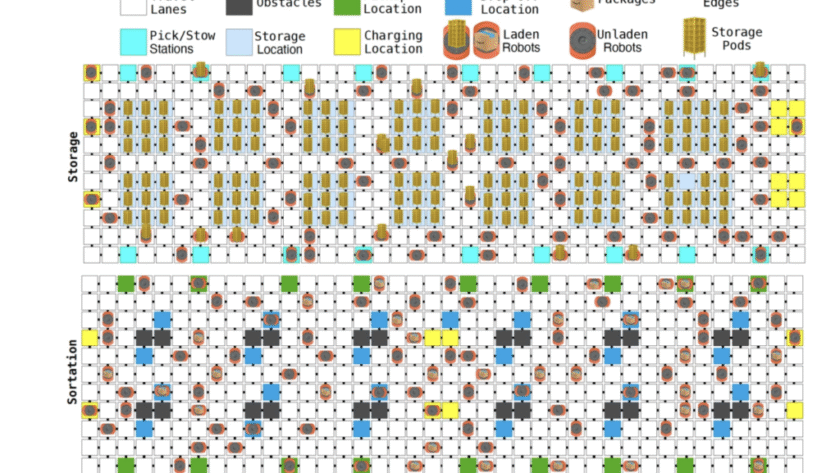
Amazon has reached a remarkable milestone by deploying its one-millionth robot across global fulfillment and sortation centers, solidifying its position as the world’s largest operator of industrial mobile robotics. This achievement coincides with the launch of DeepFleet, a groundbreaking suite of foundation models designed to enhance coordination among vast fleets of mobile robots. Trained on…
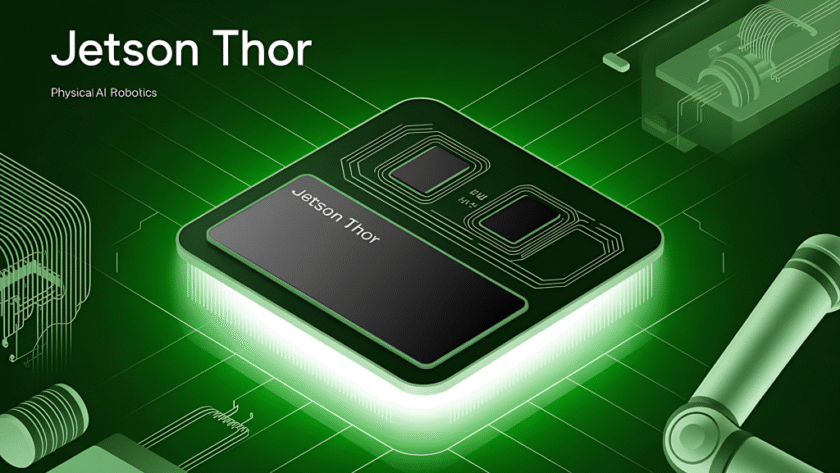
Nvidia made major waves at SIGGRAPH 2025 by unveiling a suite of new Cosmos world models, robust simulation libraries, and cutting-edge infrastructure—all designed to accelerate the next era of physical AI for robotics, autonomous vehicles, and industrial applications. Let’s break down the technological details, what this means for developers, and why it matters to the…
AI has advanced in language processing, mathematics, and code generation, but extending these capabilities to physical environments remains challenging. Physical AI seeks to close this gap by developing systems that perceive, understand, and act in dynamic, real-world settings. Unlike conventional AI that processes text or symbols, Physical AI engages with sensory inputs, especially video, and…
Robotic grasping is a cornerstone task for automation and manipulation, critical in domains spanning from industrial picking to service and humanoid robotics. Despite decades of research, achieving robust, general-purpose 6-degree-of-freedom (6-DOF) grasping remains a challenging open problem. Recently, NVIDIA unveiled GraspGen, a novel diffusion-based grasp generation framework that promises to bring state-of-the-art (SOTA) performance with unprecedented…
Estimated reading time: 5 minutes
Introduction
Embodied AI agents are increasingly being called upon to interpret complex, multimodal instructions and act robustly in dynamic environments. ThinkAct, presented by researchers from Nvidia and National Taiwan University, offers a breakthrough for vision-language-action (VLA) reasoning, introducing reinforced visual latent planning to bridge high-level multimodal reasoning…
Micromobility solutions—such as delivery robots, mobility scooters, and electric wheelchairs—are rapidly transforming short-distance urban travel. Despite their growing popularity as flexible, eco-friendly transport alternatives, most micromobility devices still rely heavily on human control. This dependence limits operational efficiency and raises safety concerns, especially in complex, crowded city environments filled with dynamic obstacles like pedestrians and…
Bridging Perception and Action in Robotics
Multimodal Large Language Models (MLLMs) hold promise for enabling machines, such as robotic arms and legged robots, to perceive their surroundings, interpret scenarios, and take meaningful actions. The integration of such intelligence into physical systems is advancing the field of robotics, pushing it toward autonomous machines that don’t just…
The Challenge of Scaling 3D Environments in Embodied AI
Creating realistic and accurately scaled 3D environments is essential for training and evaluating embodied AI. However, current methods still rely on manually designed 3D graphics, which are costly and lack realism, thereby limiting scalability and generalization. Unlike internet-scale data used in models like GPT and CLIP,…
Google DeepMind has unveiled Gemini Robotics On-Device, a compact, local version of its powerful vision-language-action (VLA) model, bringing advanced robotic intelligence directly onto devices. This marks a key step forward in the field of embodied AI by eliminating the need for continuous cloud connectivity while maintaining the flexibility, generality, and high precision associated with the…